
You wrote the book. You edited the book. You probably stared at the same paragraph for three hours, questioned every life decision that led you to becoming an author, and eventually convinced yourself that yes, somebody out there actually wants to read this thing.
Then came the marketing.
Suddenly, you’re expected to be a writer, graphic designer, social media manager, publicist, email marketing expert, and website developer. Somewhere between creating Instagram graphics and figuring out why your newsletter signup form isn’t working, you realize you’ve spent more time promoting your book than actually writing the next one.
Sound familiar?
As an indie romance author, I understand that struggle intimately. I’m also a professional web designer, which gives me a slightly unusual perspective on the whole author website situation. I know what goes into building a website, but I also know how overwhelming the business side of publishing can feel when all you really want to do is write fictional people into emotionally compromising situations.
Here’s what I’ve learned: Your author website should work for you, not become another full-time job.
If you’re wondering how to build an author website that attracts readers, sells books, and establishes your author brand, I’m going to walk you through the essentials. We’ll talk about design, platforms, SEO, blogging, marketing, and even the uncomfortable financial realities of selling books.
And yes, I’ll show you how my own website fits into the equation.
Why Every Indie Author Needs a Professional Website
An author website is your personal corner of the internet: a place where readers can discover your books, learn about you, subscribe to your newsletter, and find reliable links to purchase your work.
Unlike social media profiles, your website gives you greater control over your content, presentation, and reader experience. You aren’t depending entirely on a social media algorithm to decide whether someone sees your latest release announcement.
Think about it. Instagram could change its algorithm tomorrow. TikTok could become less useful for your audience. A retailer could change its policies, and suddenly the promotional strategy you’ve spent months building needs to be reconsidered.
Your website gives your author business a more stable foundation.
It also creates a natural destination for readers who discover you somewhere else. Maybe someone sees your book at a signing, finds your name in a Goodreads review, or clicks through from a social media post. When they search for you, your website should make it easy to find the book that caught their attention.
Your Website Is an Extension of Your Author Brand
Romance readers know what they like, and they often know it immediately.
Someone who loves dark, morally complicated romance probably expects a different atmosphere than someone looking for a sweet, small-town love story. Your website doesn’t have to scream your subgenre from every corner, but it should communicate the emotional experience readers can expect from your books.
I write contemporary, erotic, and paranormal romance, so I want my website to reflect that combination of intimacy, tension, and unapologetic sensuality. I don’t want readers to feel like they’ve wandered into a corporate consulting website. I want them to recognize that they’re in the right place for stories that aren’t afraid of desire.
This is where author branding becomes especially important. Your colors, typography, photography, book covers, and written voice should feel like pieces of the same identity.
If you’re still figuring out what makes your author persona distinct, I’ve written more about finding an author’s identity beyond their name. It’s a useful starting point before you begin making visual design decisions.
The 90/10 Rule for Authors: Write More, Market Smarter
One question that comes up in author marketing discussions is: What is the 90/10 rule for authors?
In the context of this article, the 90/10 rule is a practical guideline suggesting that authors devote roughly 90 percent of their available creative and business-development time to writing and 10 percent to promotion. It’s not an established publishing industry law, and the right balance will vary depending on your publishing schedule, business model, and career stage.
The principle is simple: Don’t let marketing consume so much of your energy that you stop producing the books you’re trying to sell.
I understand why that happens. Marketing gives us something measurable to do when writing feels difficult. We can redesign a banner, tweak a book description, schedule social posts, or obsess over website analytics and convince ourselves we’re being productive.
Meanwhile, the manuscript is sitting there, waiting.
I’ve talked about this frustration in The Messy Reality Behind Happily Ever Afters, because writing around a full-time job and everything else life throws at you isn’t particularly glamorous.
How Your Website Supports the 90/10 Approach
A properly organized website can reduce repetitive promotional work by giving you one central place to send readers.
Instead of rewriting a lengthy explanation about where to buy your books every time someone asks, you can send them to your book library. Instead of individually announcing every update to interested readers, you can invite them to join your newsletter.
Your website can handle some of the organizational work while you concentrate on storytelling.
For example, you might spend one afternoon each month updating your book pages, scheduling a blog post, reviewing newsletter signups, and checking that your purchase links work. You can then reuse that content in your social posts rather than starting from scratch every day.
That’s a far more sustainable approach than treating every social media platform like a hungry little monster that needs feeding every few hours.
Choosing the Best Platform for Your Author Website
Let’s get into the technical side of things.
One of the first decisions you’ll make is choosing a website platform. There isn’t a single perfect solution for every author, because your budget, technical confidence, publishing plans, and business goals will influence which option makes the most sense.
Here are some of the best platforms for author websites.
WordPress: Flexibility and Long-Term Control
I’m admittedly biased toward WordPress because I work with it professionally, but I also believe it’s an excellent option for indie authors who want flexibility.
WordPress can support everything from a simple author homepage to a comprehensive website with individual book pages, blog articles, newsletter integrations, custom book collections, and direct sales options.
You can begin with a relatively modest setup and expand as your backlist grows. That scalability is particularly useful for romance authors who plan to publish multiple books, interconnected series, or different subgenres.
The tradeoff is maintenance. A self-hosted WordPress website requires hosting, updates, backups, security considerations, and occasional troubleshooting. You’ll either need to learn those responsibilities or work with someone who can manage them.
Squarespace: An Attractive, Managed Solution
Squarespace is a reasonable choice for authors who want a polished website without spending much time managing its technical infrastructure.
Its templates and visual editing tools make it relatively approachable, especially if your primary goals are showcasing books, maintaining an author biography, and collecting newsletter subscriptions.
The tradeoff is that custom functionality and design flexibility can be more constrained than a fully customized WordPress installation.
For an author who wants a relatively simple online presence, that may be a perfectly acceptable compromise.
Wix: Beginner-Friendly Website Building
Wix offers a visual website builder that can appeal to authors who prefer arranging their own pages without writing code.
It can support book listings, basic blogging, contact forms, and marketing integrations. However, authors should evaluate their chosen plan, available features, and long-term customization needs before committing.
If you anticipate building a complex catalog or making significant structural changes later, it’s worth considering how easily the platform can grow with you.
Author-Specific Website Services
Some services specialize in creating websites for writers, often with book-focused templates, author biographies, mailing list integrations, and support designed around publishing.
These can be useful for authors who don’t want to manage a general-purpose website builder. However, you should investigate what happens if you decide to leave the service, how much control you have over your content, and whether your preferred retailers and email providers are supported.
The best platform isn’t necessarily the one with the most features. It’s the one that supports your publishing business without overwhelming you.
What Does an Author Website Cost?
Your costs will depend on your platform and how much work you do yourself.
A simple DIY website may require a domain name, hosting or a website-builder subscription, and possibly a paid template or email marketing service. A custom website designed by a professional will generally require a larger initial investment, with ongoing hosting and maintenance costs afterward.
As an illustrative planning range rather than a current vendor quote, a small self-managed author website might cost roughly $100–$400 per year in basic services, excluding your labor and optional premium tools. Professional design and advanced functionality can raise that investment substantially.
Always compare current prices and renewal rates before purchasing anything. The cheapest introductory plan isn’t necessarily the most affordable long-term solution.
Essential Features Every Author Website Should Have
You don’t need a complicated website with twenty different pages to look professional.
You need a website that makes sense to readers.
When someone arrives, they should immediately understand who you are, what you write, and where they can buy your books. Everything else should support those three goals.
A Homepage That Establishes Your Brand
Your homepage is your introduction.
It should feature your author name, a clear description of your genre or storytelling style, compelling visuals, and an obvious next step. That next step might be browsing your books, discovering your latest release, or joining your newsletter.
For romance authors, the homepage is also an opportunity to establish mood. A paranormal romance author might lean into atmospheric imagery, while a contemporary romantic comedy writer might use playful colors and energetic typography.
Whatever your aesthetic, clarity should always come before decoration.
A Book Library That Makes Buying Easy
Your books should be the stars of your website.
Every book deserves a dedicated page or clearly organized listing that gives readers enough information to decide whether it’s right for them. At minimum, include the cover, title, series information where applicable, a compelling description, and purchase links.
For romance, I also recommend clearly communicating tropes, subgenres, and relevant content information. Readers who love age-gap romance, forced proximity, paranormal relationships, or why-choose dynamics often search for those experiences specifically.
On my own website, readers can browse my book library to discover stories that fit their tastes.
The easier you make discovery, the fewer obstacles stand between someone being interested in your book and actually purchasing it.
An About Page That Sounds Like a Human Being
Please don’t write your author biography like you’re applying for a position at a law firm.
Unless, of course, you’re writing legal thrillers and that’s somehow part of the aesthetic.
Readers want to know something about the person behind the stories. They might want to understand what inspires you, why you write your genre, or what makes your books different.
Your biography should feel approachable and authentic without requiring you to share anything you’re uncomfortable making public.
For pen-name authors, this distinction is especially important. You can create a genuine connection with readers while maintaining appropriate boundaries around your private life.
A Newsletter Signup That Offers Real Value
Your email list is one of the most useful tools in your author marketing strategy.
When someone subscribes, they’re giving you permission to contact them directly rather than relying entirely on a social platform to deliver your announcements. That makes newsletters valuable for release news, preorder reminders, exclusive excerpts, and reader updates.
Give people a reason to subscribe.
Maybe it’s early access to a cover reveal, a bonus scene, or the opportunity to hear about your next release before everyone else. Whatever you offer, make sure you can consistently deliver it.
Your signup form should also clearly explain what readers are agreeing to receive and link to your privacy information.
A Blog, Contact Page, and Mobile-Friendly Design
A blog gives you room to share your writing process, connect with readers, and publish useful content that can be discovered through search engines.
A contact page gives bookstores, reviewers, event organizers, and readers an appropriate way to reach you. You can also provide a separate professional email address for business inquiries.
Finally, your website needs to work on mobile devices. Text should be readable, menus should be usable, forms should function, and purchase buttons should be easy to tap.
A beautiful website that frustrates someone trying to buy your book isn’t doing its job.
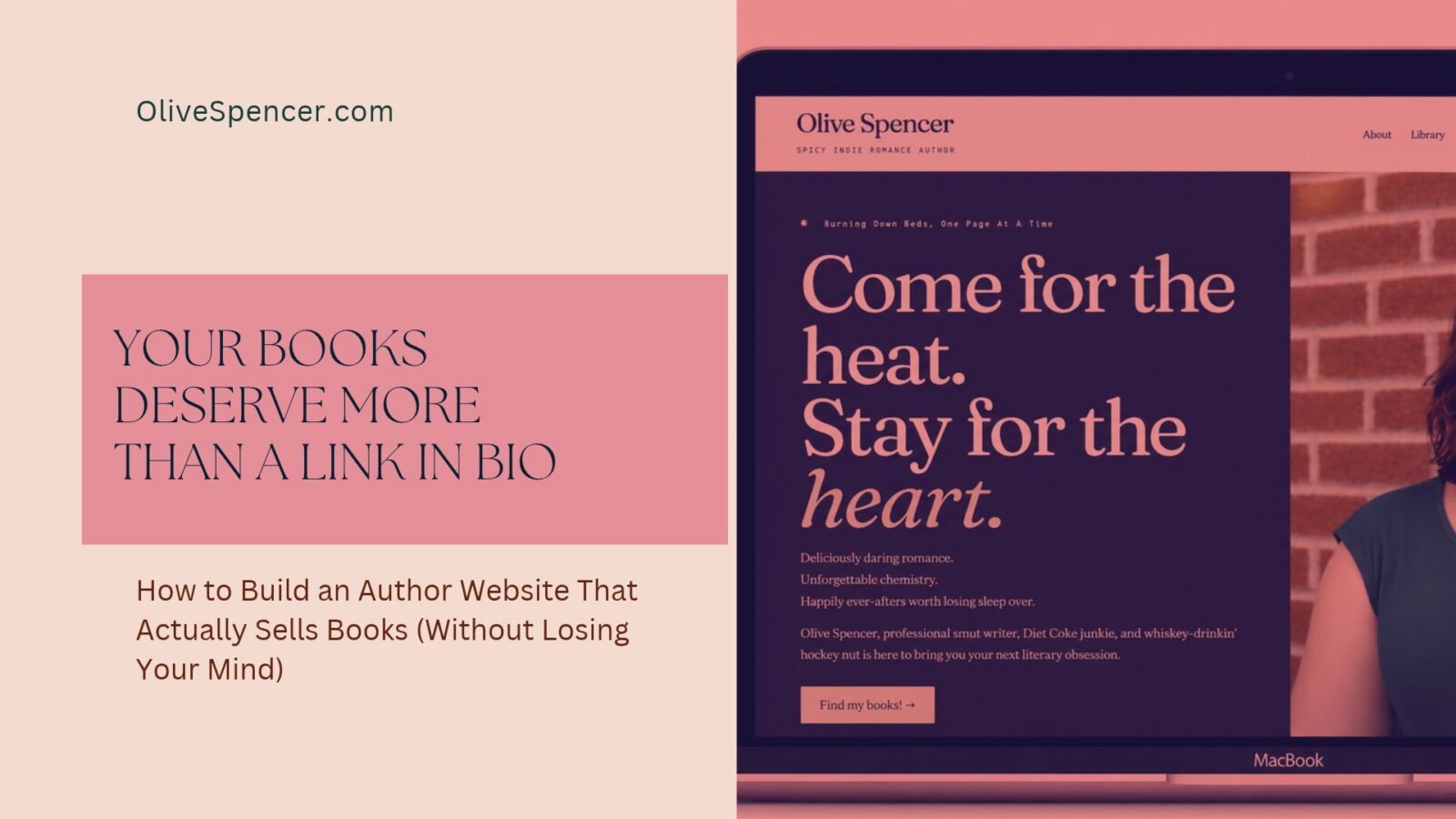
Behind the Scenes: Who Built the Olive Spencer Website?
Here’s something you might not know about me: alongside writing romance, I work professionally in website design and development.
The Olive Spencer website was built by Katherine of Katherine Magpie Design. Yes, that’s also me, working under my design business rather than my romance author name.
That combination of careers has shaped how I approach my author platform. I don’t just think about how a website looks. I think about how readers move through it, how easily they can discover books, and whether the design supports the author behind the brand.
When building Olive Spencer’s website, the goal was to create something that felt appropriate for my books without sacrificing functionality. I needed a recognizable author identity, a book library that could grow with my catalog, and a blog that gave me space to share more than release announcements.
I also wanted the freedom to change things as my publishing business evolved.
That’s one of the advantages of approaching author website design strategically instead of choosing a template solely because the colors are pretty.
If you’re building your own author platform and need help translating your books into a cohesive online experience, Katherine Magpie Design focuses on website design for romance authors.
And if you’re the DIY type, don’t worry. You can apply many of the same principles without hiring a designer.
Creating a Blog That Attracts Romance Readers
Creating a blog for authors can be a useful long-term marketing strategy, but only if you’re publishing content that gives people a reason to read it.
A blog filled exclusively with repetitive purchase announcements probably won’t encourage readers to linger. However, thoughtful articles about your writing process, your books, and the subjects your audience cares about can create opportunities for discovery and connection.
The key is choosing topics that serve both your readers and your author brand.
What Should Romance Authors Blog About?
Start by considering what readers might enjoy learning about your stories and creative process.
Some ideas include:
- Behind-the-scenes updates about works in progress.
- Explanations of your favorite romance tropes and why you love writing them.
- Character inspiration, playlists, and research discoveries.
- Sneak peeks and bonus material from upcoming releases.
- Writing advice for aspiring romance authors.
- Reflections on the challenges of independent publishing.
On my blog, for example, I discuss everything from romance novel plot structure to how to write romantic tension.
Those subjects relate naturally to the stories I write while also giving aspiring authors useful information.
I also share personal experiences about writing, publishing, and navigating the creative process. That kind of content helps readers understand the person behind the books without turning every article into a sales pitch.
How Often Should Authors Publish Blog Posts?
Consistency matters more than an ambitious schedule you can’t maintain.
If you can publish one thoughtful article each month, start there. If quarterly updates are more realistic, that’s fine too. A sustainable schedule is better than posting daily for two weeks and disappearing because you’ve exhausted yourself.
You can also repurpose content across platforms.
A blog post about your favorite romance tropes might become a newsletter discussion, several social media posts, or inspiration for a short video. One substantial piece of content can support multiple marketing channels without requiring you to create something entirely new each time.
SEO for Authors: Helping Readers Find Your Books
Search engine optimization, or SEO, is the process of making your website easier for search engines to understand and potentially recommend to relevant searchers.
That sounds technical, but the underlying goal is straightforward: Help people find the information they’re already looking for.
If someone searches for your author name, book title, or a topic closely related to your work, you want your website to have a reasonable opportunity to appear in the results.
Start With Your Author Name and Book Titles
Every author should prioritize clear, descriptive page titles and content for their own name and books.
Your book pages should use the actual book titles in headings and metadata. Your author biography should identify you consistently, and your homepage should make your genre and author identity obvious.
This is especially helpful if you write under a pen name or publish across multiple subgenres.
Use Keywords Naturally
Keywords help identify what a page is about, but they shouldn’t make your writing sound robotic.
For example, an article about building an author website might naturally use phrases such as “author website design tips,” “best platforms for author websites,” and “how to build an author website.”
Those phrases belong where they support the explanation, not where they interrupt a perfectly good sentence.
Write for people first. Search optimization should make your content clearer, not less enjoyable.
Pay Attention to Technical SEO
Technical details matter, too.
Your website should use secure HTTPS connections, load efficiently, provide descriptive alternative text for meaningful images, and work properly on mobile devices. It should also have a logical navigation structure and an XML sitemap that helps search engines discover your pages.
Structured data, sometimes called schema markup, can provide additional context about your organization, articles, and books when implemented correctly.
If you’re attending local book signings or literary events, dedicated event information can also help visitors find the details they need. Local search optimization may be useful when your author business has a legitimate local presence.
None of these improvements guarantees first-page rankings. Together, however, they create a stronger technical foundation for discoverability.
How Many Books Do You Need to Sell to Make $100,000?
Let’s talk about money, because there’s a lot of romanticizing the author lifestyle and not nearly enough discussion about the business mathematics behind it.
One common question is: How many books do I need to sell to make $100,000?
The answer depends on how much money you actually earn per copy, not simply the retail price printed on the book.
For example, suppose you sell an ebook for $6.99 and hypothetically receive 70 percent of that price before any applicable delivery fees, taxes, or other adjustments.
Your estimated earnings would be approximately $4.89 per copy.
To reach $100,000 in gross author royalties at that rate, you would need to sell approximately 20,438 copies.
That’s a very different number from dividing $100,000 by the retail price, because the full retail price isn’t necessarily what reaches your bank account.
Here’s how the calculation works:
Books needed = Target earnings ÷ Net earnings per copy
If your actual earnings are $3 per book, you’d need approximately 33,334 sales to reach $100,000. If you earn $5 per book, you’d need 20,000 sales.
These are simplified illustrations, not income guarantees. Real earnings depend on retailer terms, pricing, print costs, delivery fees, returns, discounts, taxes, and other business expenses.
Is Selling 3,000 Copies of a Book Good?
Absolutely, selling 3,000 copies can be a meaningful accomplishment, especially for an independent author building a readership.
But whether it’s financially successful depends on your expenses, royalty structure, timeframe, and personal goals. Selling 3,000 copies over several years has different implications from selling the same number during launch week.
At an illustrative $3 net royalty per copy, 3,000 sales would generate $9,000 before accounting for additional business expenses and taxes.
That might be an excellent return for a low-cost release or disappointing for a book that required an expensive advertising campaign.
It’s also important to recognize that authors measure success differently.
For some, the goal is replacing a full-time salary. For others, it’s earning enough to fund the next release, building a loyal readership, or simply knowing that people are genuinely enjoying their work.
I’ve written about my own relationship with publishing success in The Messy Reality Behind Happily Ever Afters, because sometimes the moments that matter most have very little to do with a sales dashboard.
Can an Author Website Increase Book Sales?
A website can support book sales, but it won’t automatically generate them just because it exists.
You still need to bring relevant visitors to the site, give them compelling reasons to explore your books, and make purchasing straightforward.
Think of your website as the foundation of your marketing system rather than a magical book-selling machine.
The strongest author businesses often develop several complementary channels: retailer sales, direct sales where practical, newsletters, reader recommendations, book events, and an expanding backlist.
Your website can connect those channels into one coherent reader experience.
How to Market Your Romance Novel Through Your Website
Now that you’ve built the foundation, what do you actually do with it?
Start by thinking about the journey someone takes from discovering your name to becoming a reader.
They might encounter a social media post about your latest release, click through to your website, read the description, explore your other books, and decide to purchase one. Or they might subscribe to your newsletter because they’re interested but aren’t ready to buy yet.
Both outcomes can be valuable.
Create Clear Paths to Your Books
Every important page should give visitors a sensible next step.
Your homepage might feature your newest release. A blog post about a specific romance trope might link to one of your books featuring that trope. A newsletter might send subscribers to an exclusive excerpt or preorder page.
Those connections should feel relevant rather than forced.
Someone reading an article about romantic tension may be interested in the storytelling behind your books, but that doesn’t mean every paragraph needs a giant BUY NOW button.
Sometimes a simple invitation to explore your library is enough.
Use Your Newsletter to Build Relationships
Your email list is particularly useful for nurturing relationships with readers over time.
Not every subscriber will buy every release, and that’s perfectly normal. Your goal should be to create an enjoyable experience that makes readers want to keep hearing from you.
Share updates, talk about your characters, offer occasional behind-the-scenes material, and celebrate new releases.
Treat subscribers like people who enjoy your stories, not sales opportunities waiting to be converted.
Track What Actually Works
Website analytics can help you understand which pages attract visitors and which links receive attention.
You might discover that a particular blog article brings in search traffic, that readers frequently visit your book library, or that your newsletter signup page needs clearer wording.
Use that information to make practical improvements.
Just don’t become so obsessed with analytics that you spend more time refreshing a dashboard than writing your next chapter. Trust me, that rabbit hole is surprisingly easy to fall into.
Your Author Website Doesn’t Need to Be Perfect. It Needs to Work.
Here’s the thing I wish more indie authors understood: You don’t need a massive website, an enormous marketing budget, or a complicated sales funnel to establish a professional online presence.
You need a recognizable author identity, a clear collection of books, reliable ways for readers to connect with you, and a website that makes those experiences enjoyable.
Start with the essentials. Build a homepage, create your book listings, write an authentic biography, and set up your newsletter. Once those pieces are working, you can expand into blogging, search optimization, and more sophisticated marketing.
And remember that your website is allowed to grow with you.
Your first book won’t be your last. Your writing style may evolve, your catalog may expand, and your marketing priorities may change. A thoughtful website gives you room for all of that.
As someone who spends her professional life designing websites and her creative life writing romance, I’ve learned that the best author platforms aren’t necessarily the flashiest.
They’re the ones that make it easier for readers to fall in love with your stories.
Ready to Give Your Books a Website Worthy of Them?
Your stories deserve more than a forgotten social media post and a collection of broken purchase links.
If you’re an indie romance author looking for a website that reflects your brand, showcases your books, and helps readers discover your work, visit Katherine Magpie Design. It’s the design business behind the Olive Spencer website, and its focus is helping romance authors build an online presence that feels as distinctive as their stories.
And if you’re here because you love romance rather than website development, you’re always welcome to explore my books and discover what I’ve been writing.
Because at the end of the day, the website is just the beginning.
The real magic happens when someone opens your book and forgets about the rest of the world.
Frequently Asked Questions About Author Websites
What is the 90/10 rule for authors?
The 90/10 rule is a suggested time-management approach that prioritizes writing for roughly 90 percent of an author’s available creative and business-development time, leaving 10 percent for marketing. It isn’t a universal publishing rule, and authors preparing for a launch may need a different balance. The goal is to prevent promotional responsibilities from overwhelming the work of writing books.
How many books do I need to sell to make $100,000?
The number depends on your actual earnings per copy after retailer deductions and applicable costs. At $5 per copy, you’d need 20,000 sales to generate $100,000 in author earnings before other business expenses and taxes. At $3 per copy, you’d need approximately 33,334 sales.
Is selling 3,000 copies of a book considered successful?
Selling 3,000 copies can be a significant accomplishment for an independent author, especially when building an audience. Financial success depends on production expenses, advertising costs, royalty rates, and how quickly those sales occur. It’s more useful to compare results against your own publishing goals than an arbitrary universal benchmark.
What are the best platforms for building an author website?
WordPress, Squarespace, Wix, and specialized author website services can all be viable choices. WordPress offers extensive flexibility, while managed website builders may require less technical maintenance. The best option depends on your budget, technical comfort, desired functionality, and long-term publishing plans.
How can I market my romance novel through my author website?
Start with compelling book pages, clear purchase links, newsletter signup opportunities, and content that appeals to your ideal readers. Use social media, email marketing, and relevant blog articles to direct interested visitors to your website. Make it easy for readers to discover your books and maintain a relationship with you between releases.
What essential features should every author website include?
An effective author website should include a homepage, book listings, author biography, newsletter signup, and contact information. Mobile responsiveness, clear navigation, and reliable purchase links are equally important. A blog, event information, and additional reader resources can be added as your publishing business grows.


